Writing the Small Loops in Hiragana: な, ぬ, ね, は, ほ, ま, み, む, よ, る and す
 Hiroki Obara · DeveloperStudyX Japanese Letters TracerHow-To
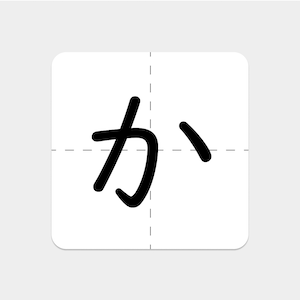
The third stroke of は (ha) runs straight down, then turns left into a small loop, crosses the vertical line and leaves to the right. Several hiragana have a loop like this, where the line turns round and closes on itself.
This article looks at the eleven basic hiragana (no dakuten) whose loop is visible in the textbook typeface used in Japanese schools, grouped by which stroke the loop is on and where.
Strokes in Japanese school handwriting
Japan’s Ministry of Education (MEXT) publishes a commentary on the national curriculum for Japanese at elementary school, the Shōgakkō Gakushū Shidō Yōryō Kaisetsu, Kokugo-hen (2017), in Japanese. In the handwriting section for grades 1 and 2, it lists the kinds of strokes that make up a character: horizontal, vertical, left sweep, right sweep, fold, curve, bow and dot. These are the parts of kanji, and the commentary says the lines that make up kana are taught together with them.
The same passage describes the form of a character as the rough overall shape built up by its strokes, and asks teachers to have children grasp that rough shape before writing, so that they do not produce badly distorted forms.
Loops at the foot of a vertical line: な, は, ほ, ま, よ
Stroke 4 of な (na), stroke 3 of は (ha), stroke 4 of ほ (ho), stroke 3 of ま (ma) and stroke 2 of よ (yo) all start as a vertical line and then loop.
When the line reaches the bottom it turns left, comes back up, crosses the vertical line and leaves to the right. The loop is wider than it is tall and sits in the lower part of the character. In all five, the loop is on the last stroke.
Loops at the end of a curving line: ぬ, ね
ぬ (nu) and ね (ne) both have two strokes, and both loop at the end of stroke 2.
The line swings round to the right, turns left at the bottom, comes back up, crosses itself and ends with a short tail. The loop is small and wider than it is tall.
Loops in the middle of a stroke: す, み, む
In these three, the line keeps going after the loop.
す (su) loops on stroke 2. The vertical line comes down, turns left partway to make the loop, crosses the vertical line, then carries on down and sweeps away to the left. The loop is taller than it is wide.
み (mi) loops on stroke 1. After the horizontal line, the stroke slants down to the left, makes a loop there, then stretches far to the right. The loop is long and narrow, lying along the slanting line.
む (mu) loops on stroke 2. The vertical line comes down, makes a small loop partway, continues down and turns to the right to finish. Stroke 3 is the dot at the upper right, written after that.
A loop closed by the end of the line: る
る (ru) is written in one stroke. From the short horizontal line at the top, it slants down to the left, swings round to the right and down, then turns left and comes back up.
Unlike the other ten, the line of る does not cross itself. It stops where it meets the line it has just drawn, and that closes the loop.
Which way the loops turn
In all eleven characters the loop turns clockwise. The line comes down, heads left, goes back up and then moves to the right.
Larger crossing curves: あ, お, め
Stroke 3 of あ (a), stroke 2 of お (o) and stroke 2 of め (me) also turn round and cross themselves. Their loops are large and make up a big part of the character.
Stroke 2 of ぬ has one of these large curves first and then a second, small loop at the end. Pairs that differ only in whether they loop, such as ぬ and め or る and ろ, are covered in Hiragana That Look Alike. Where looped characters fit in a practice order is in What Order to Teach Hiragana In.
Sources
- Ministry of Education, Culture, Sports, Science and Technology (MEXT), Shōgakkō Gakushū Shidō Yōryō (Heisei 29 nen Kokuji) Kaisetsu, Kokugo-hen, chapter 3, section 1, content for grades 1 and 2, knowledge and skills (3) c, in Japanese
Writing hiragana stroke by stroke with StudyX Japanese Letters Tracer
StudyX Japanese Letters Tracer is an iPhone and iPad app for practising the shapes and stroke order of hiragana and katakana.
Tap a character on the chart, and the model line grows in light grey, one stroke at a time, in the correct order. Trace it with your finger or a stylus and lift, and the next stroke of the model starts to grow. A cross guide can also be shown. The speaker button plays how the character is read.
It covers 142 characters: hiragana and katakana with their dakuten and handakuten forms. It is a one-time purchase with no ads and no in-app purchases. On iPhone it runs in landscape. A first session is described in Getting Started with StudyX Japanese Letters Tracer.

 StudyX Japanese Letters TracerPractice writing hiragana and katakanaSee the app →