Ko in Tsumego: Why a Ko Is Not the Correct Answer
 Hiroki Obara · Developer
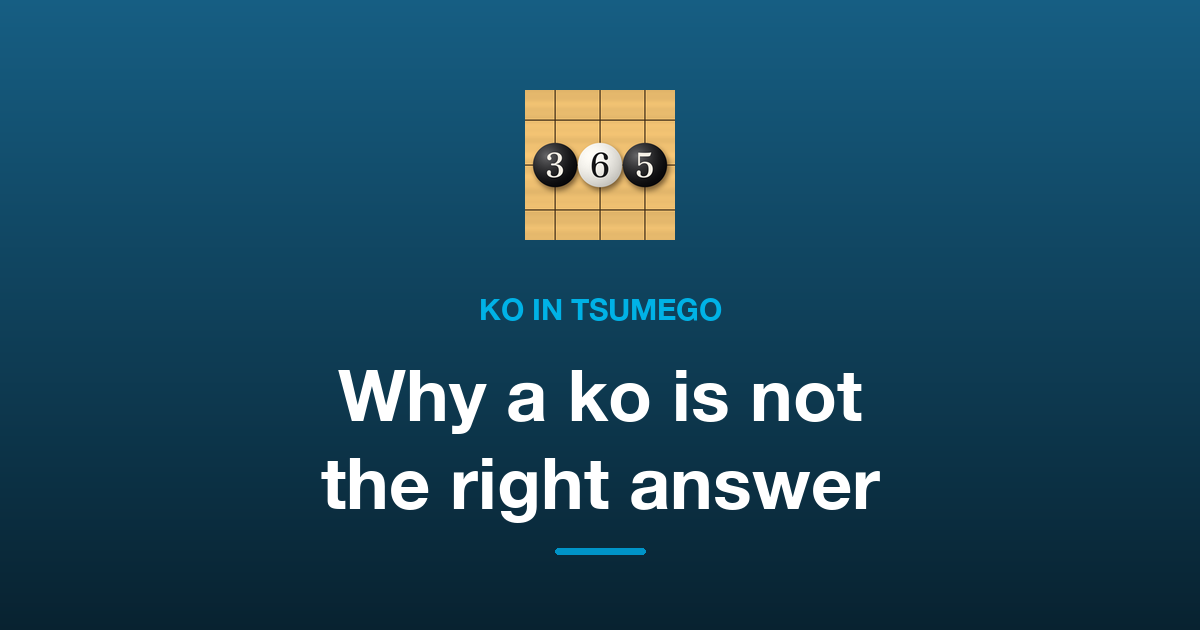
The Nihon Ki-in, the main Go association in Japan, runs rank certificate quizzes by mail. In the answers (in Japanese) to its spring 2023 quiz, one life-and-death problem in the kyu course is explained like this:
Black 1 is the vital point; after White 2, Black 3 and Black lives. If Black starts at a, then White b, Black c, White d gives a ko. If Black starts at 3, White 1 and Black dies.
One problem, three results: Black lives, ko, Black dies. The correct answer is the first line, where Black lives. The quiz sheet (in Japanese) scores the life-and-death section as 10 points for a correct answer and 0 for a failure. There is nothing in between.
The dan course in the same answers has a problem where “Black 1 is correct; against White 2 and 4, Black 5 and White dies”, followed by a line from a different first move that ends in ko. The goal is to kill White, and the ko line is written apart from the correct one.
This post looks at why tsumego treat a ko as something separate from living or dying, using the wording of the Japanese Rules of Go and the Nihon Ki-in’s beginner lessons. The ko shape itself, and the rule that you cannot take back at once, are in The Ko Rule in Go.
Living stones in the rules
The Japanese Rules of Go (in Japanese), set by the Nihon Ki-in and the Kansai Ki-in, define living and dead stones in Article 7:
Stones that cannot be captured by the opponent’s moves, or stones that, even if captured, can produce new stones that the opponent cannot capture, are called living stones. Stones other than living stones are called dead stones.
Living stones are stones that cannot be captured whatever the opponent plays. For the second half, the official commentary on the rules gives an example where stones are captured but can take back the capturing stones on the very next move.
Article 6 defines a ko as a shape where each side can take back one of the other’s stones in turn, and adds that the side whose stone was taken in a ko cannot take it back with its next move.
A ko is decided by ko threats
The Nihon Ki-in’s beginner lesson “コウ” (Ko, in Japanese) walks through a ko fight in diagrams. The side whose stone was taken cannot take back at once, so it plays somewhere else first. That move is a ko threat.
In the lesson’s example, White makes a ko threat on the right side. If Black ends the ko by connecting, Black has ignored the right side: four White stones that were already lost come back to life, and five Black stones are captured as well. If Black defends the right side, the lesson says, White’s ko threat has worked and White can now take the ko back.
In the example, the result on the right side depends on whether Black answers the threat or ends the ko. Whether the stones in a ko are finally captured or not is not decided by the ko alone.
A tsumego diagram shows only part of the board. It does not say how many ko threats there are outside it. The results given as correct, “Black lives” or “White dies”, are results that hold however many ko threats either side has.
A ko left at the end of the game
Article 7 has a second paragraph: when life and death are confirmed after play has stopped, a stone may not be taken back in the same ko.
The commentary on this paragraph (in Japanese) calls it the rule for the life and death of stones involved in a ko. Once play stops, taking back in a ko stops too, even if one side has an endless supply of ko threats.
Its example 9 asks what happens if Black, who has many ko threats, does not add a move to settle a ko and claims the game is over. The answer is that if the game ends like this, both the Black and the White stones there are dead. Many ko threats do not make Black’s stones in an unsettled ko into living stones.
Problems where a ko is correct
A ko is not always a failure. In the tesuji section of the same kyu course, one correct answer reads “Black 1 and 3 are the tesuji, and by Black 5 a ko is created.” In that problem, the line from another first move is the one marked as a failure.
Whether a ko counts as correct is decided problem by problem. When a problem asks Black to kill or to live, and a line ending in ko is written apart from the correct one, that line is not a correct answer. How to read problem headings and answers is in What Is Tsumego?.
Where to go next
The ko rule and ko threats are in The Ko Rule in Go, the basics of living shapes are in Living with Two Eyes, and counting liberties in a fight between two groups is in Semeai in Go.
Solving tsumego in Go365
Go365 contains tsumego from 1 move to 7 moves, with 1,000 problems for each length, 4,000 in total. You play Black on the board, and White replies automatically. The goal, “Black to play: kill White” or “Black to play and live”, is shown above the board. Moves are counted for both sides together, and winning a ko does not count as a correct answer.
All problems are free to solve. The app shows ads, and a one-time Remove Ads purchase turns them off. Ads you choose to watch for a hint or to refill retries are still offered after the purchase.


 Go365A Go life-and-death problem every daySee the app →